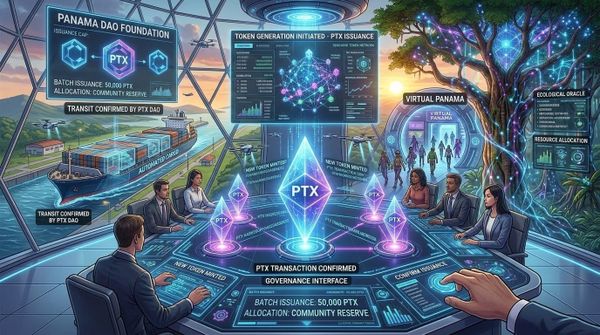
Panama token launches: why and how to issue tokens from Panama

Every token launch begins with a question that is more legal than technical: where should the tokens actually come from? Founders spend months on tokenomics, vesting schedules, and smart contract audits, and then treat the choice of issuing entity as an afterthought - a box to tick once the "real work" is done. This is a mistake. The jurisdiction in which a token is issued shapes regulatory exposure, banking access, investor perception, and tax treatment for the life of the project.
A longtime offshore hub, Panama has emerged as one of the best places through which to issue tokens. It sits alongside the BVI and Cayman as one of the default homes for web3 corporate structuring, and for a specific set of founders - early-stage, cost-sensitive, or already anchored in Panama through a foundation or operating company - it is often the better choice. This article sets out what Panama offers as a token issuance jurisdiction: the legal environment, the entity types used, how a typical structure is built, how it compares to its rivals, and the risks founders and their lawyers should weigh before committing to it.
Interested in setting up a Panama token issuance structure? Get in touch with us on contact@daospv.com
Why issue tokens from Panama?
The regulatory backdrop
Panama has no dedicated crypto, blockchain, or virtual asset legislation. There is no licensing regime for token issuers, no bespoke securities carve-out for digital assets, and no regulator actively supervising the space. For some founders, an unregulated environment sounds like a red flag. In practice, for a large slice of the market, it is the opposite - a jurisdiction that does not force early-stage projects through a licensing process they are not yet ready for, and does not impose a blockchain-specific compliance burden on top of ordinary corporate law.
This does not mean tokens issued from Panama escape regulation altogether. It means the regulation that matters is applied at the point of sale and marketing, not at the point of issuance. A Panama-issued token sold to US persons is still subject to US securities law. A token marketed into the EU still has to reckon with MiCA. Panama simply declines to add its own layer on top. For founders, this makes Panama a clean, low-friction base from which to issue - provided the downstream distribution is properly thought through.
Three reasons founders choose Panama
- Favourable and simple laws. With no bespoke crypto framework, token issuance is treated as an ordinary commercial activity carried out by an ordinary corporate vehicle. This keeps legal costs and formation timelines down, and avoids the licensing delays seen in more heavily regulated hubs.
- A deep bench of web3-native professionals. Panama has built up a genuine concentration of lawyers, accountants, and registered agents who understand token issuance, DAOs, and crypto treasury structures. This matters - plenty of "offshore" jurisdictions look cheap on paper but leave founders working with advisors who have never actually seen a TGE.
- Price. Panama entities are materially cheaper to form and maintain than their BVI or Cayman equivalents, particularly once you factor in registered agent fees, annual filings, and the cost of local directors where required.
The core entity: the Panama IBC
The workhorse of Panama token issuance is the Panama International Business Corporation (IBC), a corporate vehicle governed by Panama's long-standing corporate law. Its relevant features:
- Separate legal personality, able to contract, hold assets, and sue or be sued in its own name
- No requirement for Panamanian shareholders or directors
- No minimum capital requirement
- Strong confidentiality around beneficial ownership, subject to standard AML/KYC obligations owed to the registered agent
- Fast and inexpensive to incorporate, typically within days
For token issuance purposes, the IBC plays a specific and narrow role: it is the entity that mints the tokens, runs the TGE, and handles distribution to investors, team, and any downstream treasury vehicle. It is not usually where the protocol's governance or long-term treasury sits - that is a job better suited to a foundation, discussed below.
Panama foundations, briefly
Founders may already be familiar with the Panama private interest foundation (PIF) as a DAO wrapper or treasury vehicle - we've written about this at length elsewhere. The short version: a foundation has no shareholders, exists for a purpose or beneficiaries, and is well suited to holding a protocol's treasury, IP, and long-term governance functions. Where a project already uses a Panama foundation, pairing it with a Panama IBC as the issuing vehicle gives founders a single-jurisdiction structure - both entities registered with the same registry, the same class of local professionals, and materially less cross-border friction than pairing, say, a Cayman foundation with a BVI issuer.

Why separate the issuer from the treasury?
A recurring theme in web3 structuring is: don't let the entity that takes on the most legal risk also be the entity holding the assets you most want to protect.
Token issuance is, structurally, the highest-risk activity in the lifecycle of a project. It is the point at which securities law exposure crystallises, where investor claims are most likely to arise, and where regulators in the jurisdictions where tokens are actually sold are most likely to look. Using a dedicated Panama IBC as the issuer - separate from the foundation or operating company that holds the treasury, IP, and ongoing protocol assets - insulates the rest of the structure from that risk. If a claim does arise out of the token sale, it is contained within the issuer, not the entity holding the assets founders care most about protecting.
Typical structure
- Panama IBC (token issuer): incorporated specifically to mint the token, run the TGE, and handle distribution to investors, team, and treasury
- Panama Foundation (or other treasury vehicle): receives the foundation's token allocation, holds protocol IP, governs the DAO, deploys tokens for grants and incentives
- Operating company (optional): development entity, employer of record for the core team, or front-end operator
Flow of assets: the issuer mints the tokens and allocates them according to the tokenomics - investors, team, foundation treasury, ecosystem funds. The foundation then takes on the long-term stewardship role: deploying its allocation for governance incentives, grants, and ecosystem funding, while the issuer winds down its active role once the TGE is complete.
Key considerations before issuing from Panama
1. Securities analysis. Panama's silence on token regulation does not mean the token itself escapes securities analysis. Founders need to think carefully about what rights the token confers - governance rights, revenue share, claims on treasury - and where it will be marketed. A token that looks purely utility-based in one jurisdiction can look like a security in another. This analysis has to be done market by market, not assumed away because the issuer sits in an unregulated jurisdiction.
2. Marketing and distribution restrictions. Because Panama does not regulate the issuance itself, the discipline has to come from geo-restricting the sale, KYC'ing investors, and building appropriate legends and disclaimers into subscription documents. A Panama IBC does not give founders a free pass to sell into restricted jurisdictions - it just means Panama itself won't stop them. Other regulators will.
3. Banking and payment rails. Panama-incorporated entities can face more friction opening bank accounts than their BVI or Cayman peers, particularly with tier-one banks who remain cautious about crypto-adjacent Panamanian structures. Most issuers instead rely on crypto-native custodians, payment processors, or fiat on/off ramps that are used to working with offshore issuers, rather than trying to force a relationship with a traditional retail bank.
4. Tax. Panama operates a territorial tax system - income from outside Panama is generally not taxed in Panama. This is attractive for an issuer whose investors, team, and token holders are dispersed globally. That said, this only addresses Panama's own tax treatment. Founders and team members remain subject to tax in their own jurisdictions of residence, and the structure does not, by itself, eliminate tax obligations elsewhere. Get proper tax advice in each relevant jurisdiction - don't assume "Panama is low-tax" solves the whole picture.
5. Substance and reputation. An IBC with no real presence, no local directors, and no operational footprint in Panama is a thin structure. For some projects this is entirely fine - the issuer is a short-lived vehicle whose job ends once the TGE is complete. For others, particularly those courting institutional investors or seeking a durable public profile, some degree of local substance (a registered agent, local director, or administrative presence) helps the structure hold up to scrutiny.
Panama vs BVI vs Cayman: how the token issuance jurisdictions compare
The three most commonly used token issuance jurisdictions - Panama, the BVI, and Cayman - overlap significantly in what they offer: no bespoke crypto regulation, fast incorporation, and a professional services industry comfortable with digital assets. The differences are in degree, not kind.
Where Panama has the edge
- Cost: Panama IBCs are cheaper to form and maintain than BVI or Cayman companies, and the gap widens once local directors or presence requirements are added on the Cayman side.
- Single-jurisdiction structuring: where a project is already using a Panama foundation as its treasury or DAO wrapper, pairing it with a Panama IBC issuer keeps the whole structure within one legal system, one registry, and one set of local advisors. A BVI or Cayman issuer paired with a Panama foundation introduces an additional jurisdiction, an additional registered agent relationship, and additional cross-border considerations founders don't strictly need.
- Privacy: Panama places a strong emphasis on confidentiality of beneficial ownership, subject to the usual AML/KYC obligations owed to the registered agent.
Where BVI and Cayman have the edge
- Institutional reputation: As a token issuance jurisdiction, the BVI may carry a sronger reputation with institutional investors and larger funds. This is also the case for Cayman in relation to its role as a centre for the overall asset holding/ treasury structuring of token launches - its has a good reputation arising from its dominant position in the global funds industry. Some institutional counterparties will simply be more comfortable seeing a Cayman entity on a subscription agreement.
- Established market convention: the BVI business company paired with a Cayman foundation - the crypto catamaran - is extremely well-trodden as a token issuance structure. Most institutional investors' legal teams have seen the paperwork before, which can smooth diligence.
- Common law familiarity: both are common law jurisdictions, which some lawyers - particularly those trained in the US or UK - find more comfortable to work with than Panama's civil law framework.
The upshot: Cayman and the BVI tend to win out for (a) projects who need regulatory clarity and (b) projects doing larger, more institutional work where investor comfort and market convention carry real weight. Panama tends to win for early-stage, cost-sensitive projects, and for projects that are already anchored in Panama through a foundation and want to avoid the complexity of a multi-jurisdiction structure.
How to set up a Panama token issuance structure
Step 1: Define the tokenomics and structure
- Settle the token's rights and function before anything else - what does it confer, what can holders do with it, and does it carry any claim over revenue or treasury
- Decide whether the issuer will stand alone or sit alongside a Panama foundation or operating company
- Map out the flow of tokens from issuance through to team, investors, and treasury
Step 2: Run the securities and distribution analysis
- Work through, jurisdiction by jurisdiction, whether the token is likely to be treated as a security, and where it can and cannot be marketed
- Build KYC, geo-restriction, and investor accreditation requirements into the sale documentation
- This is best done with local counsel in your key target markets, not assumed away
Step 3: Incorporate the Panama IBC
- Appoint a registered agent, as required under Panama law
- Decide on directors - Panama does not require local directors, though some structures use them for substance purposes
- Complete AML/KYC onboarding: the registered agent will need information on the founding team, source of funds, and the intended use of the entity
Step 4: Draft the issuance documentation
- Token purchase or subscription agreements, with appropriate disclaimers, legends, and jurisdiction-specific carve-outs
- Terms of sale, including vesting schedules and lock-ups where relevant
- Any SAFT or pre-TGE agreements, if tokens are being pre-sold ahead of a generation event
Step 5: Integrate with treasury and governance
- If pairing with a Panama foundation, formalise the flow of tokens from issuer to foundation treasury
- Set up multisig wallets and define who controls them
- Establish reporting lines between the issuer and any ongoing governance structure, and plan for the issuer's role to wind down once the TGE is complete
Step 6: Execute the TGE
- Timeline from incorporation to a completed structure ready for token generation is typically a matter of weeks, not months
- Run the sale in line with the distribution plan from Step 2
- Distribute tokens to investors, team, and treasury according to the agreed allocation
Risks and limitations
Regulatory uncertainty. Panama's lack of a bespoke crypto regime is an advantage today, but it is not a permanent guarantee. Founders should build structures that can adapt if Panama - or the jurisdictions where tokens are actually sold - introduce new rules.
Institutional hesitancy. As above, some institutional investors and larger counterparties remain more comfortable with the Cayman or BVI issuance structure. For raises that are heavily weighted toward institutional capital, this is worth weighing against Panama's cost advantages.
Banking friction. Panama entities can face more resistance opening accounts with traditional banks than BVI or Cayman peers, pushing most issuers toward crypto-native banking and payment solutions instead.
Thin structures invite scrutiny. An IBC with no substance, used purely as a pass-through for a TGE, is fine for many projects but can draw more scrutiny from regulators or counterparties who expect to see some operational reality behind the entity.
Conclusion
Panama has earned its place as one of the default jurisdictions for token issuance, sitting comfortably alongside the BVI and Cayman as a serious option rather than a discount alternative. Its lack of bespoke crypto regulation, deep bench of web3-literate professionals, and low cost make it a natural choice for early-stage projects, and a particularly strong fit for founders who are already using a Panama foundation for treasury or DAO purposes and want to keep the whole structure within a single jurisdiction.
It is not the right answer for every project. Larger, institutionally backed raises may still be better served by the reputational weight of Cayman and the market familiarity of the BVI. Many projects targeting the EU will need an EU base. The right choice, as always, depends on the specific tokenomics, investor base, and distribution plan of the project in question - not on which jurisdiction happens to be cheapest or most fashionable this year.
The key insight is this: the issuing entity is not a formality to be bolted on at the end of the process. It is a structural decision that shapes regulatory exposure, investor confidence, and tax treatment for the life of the token. Choose it with the same care as the tokenomics themselves.
If you are looking to set up a Panama token issuance structure, we would be delighted to help. Feel free to message us on contact@daospv.com