DAO operations and governance: a primer
To exist, a DAO needs to get the basics rights - smart contracts, token mechanics, and the continued existence of a thriving DAO community. To flourish and to survive, what it also needs is governance discipline, treasury stewardship and clarity around who actually exercises control.
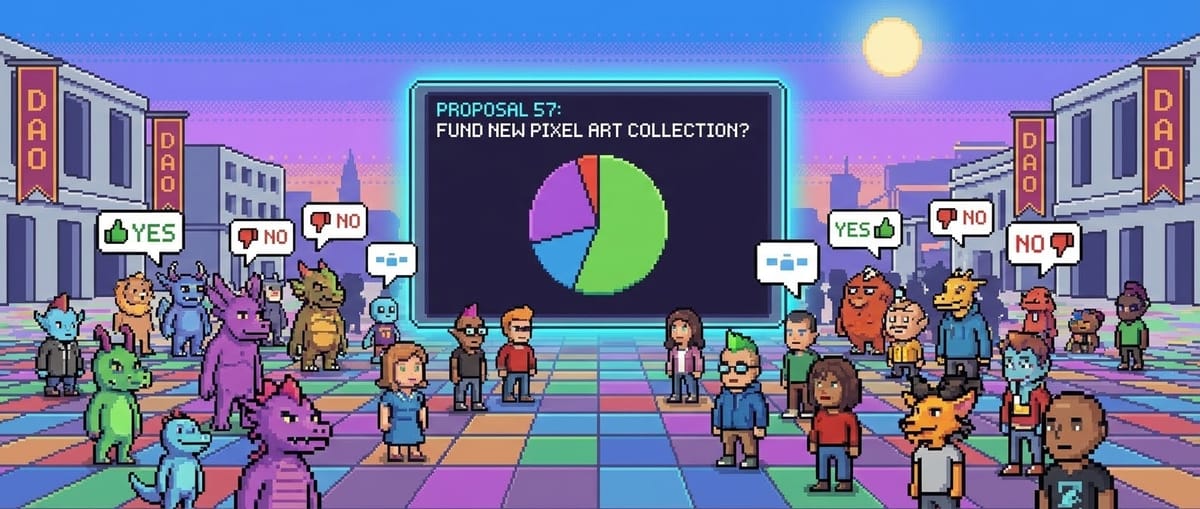
What is a DAO, that most intriguing yet confounding of web3 concepts? A DAO - Decentralised Autonomous Organisation - is a blockchain-native organisational form, one liable to confuse even the most dedicated of crypto lovers, Broadly, a DAO is a coordination system that uses token-mediated governance and smart contract execution to coordinate capital, software and human decision-making, and which may or may not be embedded within human institutional structures. They are a key part of the web3 toolset, the mechanism used to govern many of the blockchain industry's biggest and best projects, and rich in revolutionary implications for how people and projects collaborate. They are also very easy to get wrong, and pose a unique set of regulatory and operational challenges.
To exist, a DAO needs to get the basics rights - smart contracts, token mechanics, and the continued existence of a thriving DAO community. To flourish and to survive, what it also needs is governance discipline, treasury stewardship and clarity around who actually exercises control.
Voting is an excellent idea, but you do not need to be a history and politics expert to recognise that democracy brings complexity. The challenge for DAOs is that they face many of the traditional challenges of any democratic insulation, while adding in new challenges related to the functional, regulatory, and political effects of decentralisation.
This blog post is designed as a high-level snapshot view of the operational questions that matter to DAOs. It examines how serious DAOs operate in the real world - with particular focus on governance, treasury management, foundation operations and control over execution infrastructure such as multisig wallets. In subsequent blogs post we will assess DAO governance tools, DAO governance practices, and DAO wrappers.
If you would like to learn more about DAOs, or to set up a DAO wrapper, get in touch at contact@daospv.com
DAO governance
Constitutional design: what is it you actually want to build?
Most DAOs begin with a token and a voting system; at core, a DAO is a governance mechanism. Token holders can do things like submit proposals, vote on upgrades and direct treasury spending in accordance with the DAO constitutions. Actions like these are the visible manifestations of a DAO’s constitutional architecture. A constitution, however, is meant to govern something. DAOs need something to govern, a reason to exist; without this, they are merely another layer of purposeless abstraction.
Key questions founders must answer early:
- How will the existence of the DAO advance the needs of the project?
- What governance powers will the DAO actually have, now and in future?
- Why do you want the DAO to have these powers?
- What is the proposed economic role of the DAO in relation to project assets?
- How will you launch the token?
- Are DAO governance votes binding or advisory?
- Who or what executes approved proposals?
- Can governance replace directors, council members or multisig signers?
- Is there an emergency override?
The answers to those questions will help determine the regulatory profile of the DAO, how the DAO relates to the DAO community, what actions you incentivise among DAO participants, and the kind of DAO wrapper you might want to use. Further points to consider:
Token launch mechanics: How will you launch the token? The methods used in the token launch will strongly influence the ongoing operational needs of the DAO, and its regulatory profile. If it is a fair launch, the project will be more decentralized, and project founders will have less control over tokens and token supply. If it is launched initially via private sales, and the treasury controls most of the token supply, the need and legal risks of the DAo will be very different/
Voting vs execution: Some DAOs founders conflate voting with execution. In mature systems, these are distinct. Token holders may express binding intent, but execution authority typically sits with a defined group — a multisig committee, a foundation board, or an operations council. That separation is not centralisation by stealth. It is risk management - and how these risks are managed varied strongly with DAO constitutions and wrapper types.
The economic role of the DAO: A deeper question, particularly from a regulatory standpoint, is the economic role of the DAO - i.e. whether governance confers control over pooled capital that generates returns, or indeed is expected to generate returns. If token holders can vote to deploy treasury assets into yield strategies and receive proportional benefit, the economic profile begins to resemble a managed investment arrangement. Whether or not that is the intent, economic substance matters.
DAO purposes
Not all DAOs carry equal complexity or risk. DAOs undertake a mix of workstreams. These may include:
- Protocol governance: adjusting parameters, approving upgrades.
- Grant making: distributing funds to ecosystem contributors.
- Revenue management: managing protocol income streams.
- Investment: allocating pooled capital into external assets.
- Staking or yield management: operating validators or distributing staking rewards
- Utility decisions: making decisions about utility, such as for instance club memberships or in-game rights
Risk is not determined by function alone - scale, treasury size, geographic nexus, the nature of the governance powers, and degree of off-chain activity also impact a DAO’s risk profile. It is essential that founders understand the economic role of the DAO, as this affects the DAO operations, and the regulatory risks therein.
A grants DAO with a fixed treasury is fundamentally different from an investment DAO allocating capital into DeFi protocols; whether or not these are based in the USA, and the control that governance tokens give over revenue and profits, will also matter a great deal. Governance design and regulatory exposure therefore differ strongly between different DAOs. Founders who fail to think through these risks may end up designing structures that are internally inconsistent or externally vulnerable.
It is important to remember that very few DAOs exist in just one category; most are layered hybrids.
Community management
An essential point, but one somehow forgotten by some aspiring DAO founders - a well-run DAO requires effective community management
In most DAOs - especially the more mature DAOs - token holders are dispersed, pseudonymous and globally distributed. Governance discussions occur through forums, Discord servers, Telegram groups; votes may also occur on these, or through on-chain voting platforms. Without deliberate community management, participation decays, discussions fragment, and governance becomes dominated by a small, self-selecting minority. Over time, this erodes legitimacy and increases governance capture risk.
Community management therefore sits at the intersection of communications, governance design and political theory. It is fun, interesting, and easy to get wrong.
At minimum, DAO founders need to think through:
- Proposals: how they want proposals to arise, how and where and how often discussions on these proposals should take place, whether there should be a quorum, whether there are weighted votes, etc.
- Participation incentives: Many DAOs suffer from poor governance participation. To mitigate this, DAOs should consider things like recognition and rewards for participation, delegating certain discussions or decisions to specific sub-committees, etc
- Conflict resolution: It is all too easy for conversations to spiral out of control and damage the DAO. Project leads should thing through norms on communication, resolution pathways , sanctions, and decision transparency
Governance fatigue and power concentration
Voting is a fine and noble thing - but in both blockchain DAO and real-world democracies, participation can be low. Over time, participation in DAO governance typically declines. There are many reasons for this. Voters can be asked to vote on too many things, too often; they can lose faith in the project; they can come to consider that proposal discussions are badly run and frustrating. This creates a familiar paradox: while token distribution may be broad, decision-making power becomes concentrated among a smaller, more active group willing to make the continued effort to participate.
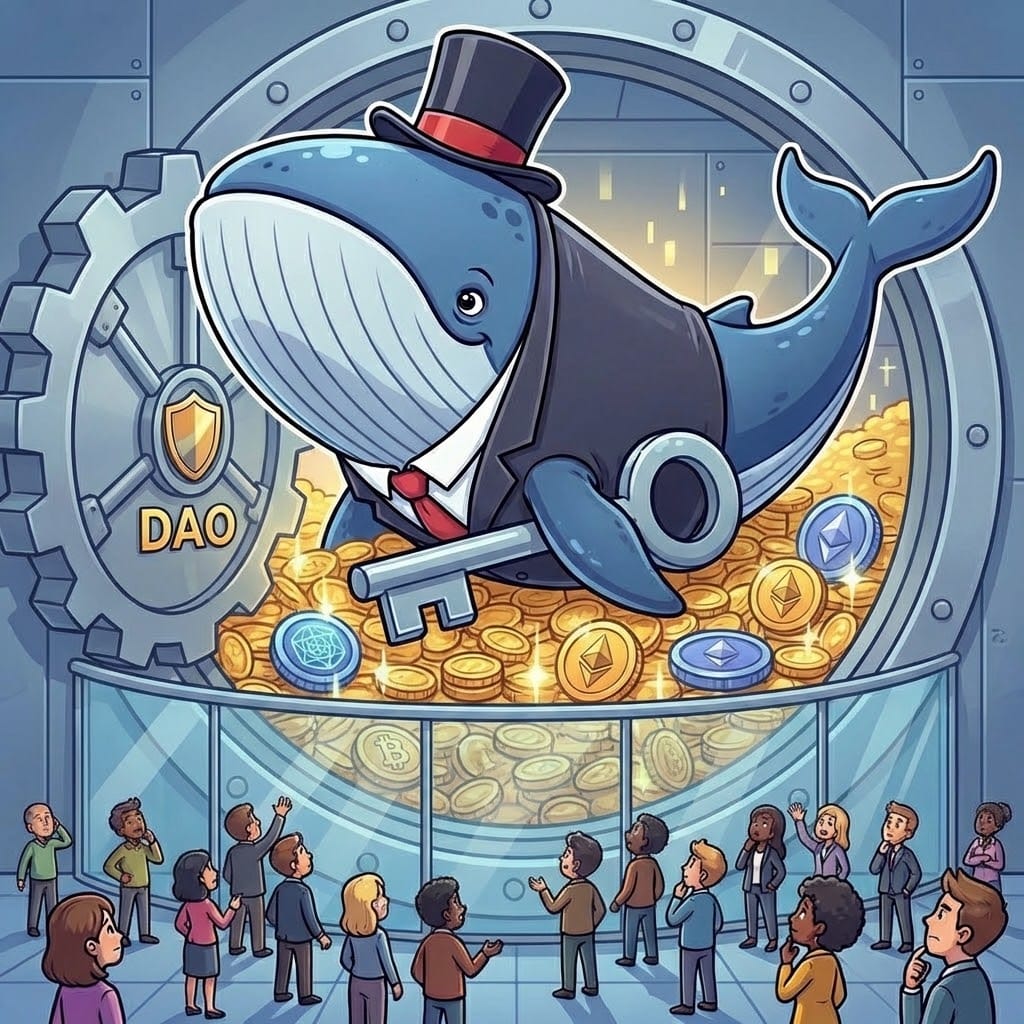
An additional challenge faced by DAOs - one not seen in the West since the advent of modern liberal democracy - is property ownership can often lead to some token holders having more votes than others. If one token = 1 vote, whales can govern the DAO to their benefit. At the extreme end, this can lead to rug pulls and treasury abuse.
Addressing fatigue: Voters get fatigued. Delegation frameworks partially address this by allowing token holders to assign voting and deliberative power to recognised delegates, and/or to particular subcommittees. However, delegation aids efficiency - but it can also simply empower new elites.
Addressing power concentration: Measures to mitigate whale dominance include things
- Vote weight engineering: Some DAOs use vote caps, limiting the maximum voting power any single wallet can exercise, regardless of holdings. Others use quadratic voting, where voting power scales with the square root of tokens held rather than linearly. Still others use conviction voting (influence increases over time if tokens remain committed) and time-weighted voting.
- Bicameral governance: Some systems separate proposal initiation from approval, or require multiple bodies to consent. For example, a token vote may pass a proposal, but an elected council or technical committee must confirm feasibility. Others create separate “houses” (e.g., token holders and community representatives) whose approval is jointly required
- Quorums and supermajority threshold: Supermajority thresholds (e.g., 60% or 66%) increase the cost of unilateral dominance
- Lockups and staking requirements: to vote, token holders can be required to stake or lock up their tokens
Sophisticated DAOs monitor:
- Voter turnout trends
- Concentration of voting power
- Delegate performance metrics
- Governance capture risks
Ignoring governance fatigue leads to declining engagement and the slow death of the DAO. Ignoring power concentration means the DAO is less and less decentralized, and increasingly vulnerable to the wishes and manipulation of a small group. None of these outcomes are good.
Early vs mature DAOs: horses for courses
It will surprise no one to learn that early stage DAOs are very different to mature DAOs.
Early stage: DAO projects tend to be small, informal, and dominated by project founders. Documentation is thin, and responsibilities may be poorly defined. Given reliance on project initiators, the DAO is often relatively centralised at this stage. This has regulatory impacts - if it issues a security like token, this centralisation may contribute to regulators considering the asset to be a security.
Mature DAOs: These will be larger, undertaking more activities, and will be more decentralised.
- Scale and complexity: The DAO may operate multiple sub-DAOs, funding streams, or protocol upgrades. Treasury management becomes strategic rather than transactional.
- Roles & committees: Clear separation emerges between token holders, delegates, working groups, core contributors, and service providers. Authority is structured rather than socially assumed.
- Procedural sophistication: There may be delegate systems, bicameral models, risk committees, formal proposal pipelines, or staged voting processes. Governance is no longer just token-weighted polling.
- Treasury: the DAOs treasury is likely to be much larger, with many more treasury related operations taking place.
All of this means that mature DAOs have very different operational needs to early stage DAO projects.
Many DAOs are marked by ‘progressive decentralisation - they get more decentralized over time’.
DAO wrappers matter
Not all DAOs want or need to get a legal wrapper; many can do just fine without them. However, the more value a DAO holds, and the more activities it engages in, the more likely it is that some form of wrapper will be very useful in protecting the DAO and DAO community.
The different wrapper types have different DAO management profiles. Foundation-style wrappers detach the DAO itself from the legal entity that acts on its behalf; the will of the DAO is expressed by actions of the foundation and the human directors / councillors who control it. ‘Fully wrapped’ DAO, by contrast, include the whole DAO within the entity, tend not to require directors, and tend to enable smart contract based automation of the actions of the legal entity itself. Naturally, this heavily impacts DAO management
See here for more information on the different DAO forms.
Treasury management: the core operational function
If governance is the constitutional layer of a DAO, treasury management is its operational heart. In practice, many DAOs are treasury-centric systems. The treasury is the mechanism that binds contributors together. It is not just the heart of the DAO - it is the incentive engine. Without it, governance has no object.
Many serious DAOs control significant on-chain assets - often in volatile native tokens supplemented by stablecoins. In bull markets, treasury discipline appears less urgent. In downturns, it becomes existential.
At its simplest, a DAO treasury consists of tokens held in a multisig wallet or governed by smart contracts. These assets may include native governance tokens, stablecoins, ETH or other crypto assets. Over time, treasuries can grow substantial, sometimes exceeding the operational sophistication of the governance framework managing them.
Management and control of the treasury is central to regulatory risk analysis: to re-emphasise an earlier a point - the question of whether there is a treasury, what is in the treasury, who controls the treasury, and what rights token holders have over the treasury is absolutely central to the regulatory risk profile of the DAO. This matters for the long-term success of the project, but also for its daily operations - regulators will look to see who is exercising what control over treasury assets.
Treasury management and DAO operations: More broadly, treasury management affects DAO operations in 3 ways:
- Runway and resilience: The composition and management of the treasury determine how long a DAO can operate and how well it can withstand volatility. If a DAO treasury is badly managed - little diversification, low liquidity, poor contingency planning - it may fail to survive a crisis.
- Strategic direction: Treasury allocation is strategy expressed in capital form. The choices made on how a DAO treasury builds and spends its capital are integral to how a DAO-governed project evolves.
- Legitimacy: Treasury stewardship underpins internal and external trust. Community members and external stakeholders will more deeply engage wth the DAO if they now the treasury is being run in an accountable, responsible, and transparent manner.
Treasury policy is central to the success of a DAO.
Well-structured DAOs adopt written treasury policies that address:
- Diversification targets
- Runway planning (e.g., 12–24 months operating capital)
- Spending thresholds
- Asset allocation limits
- Counterparty exposure limits
- Risk assessment criteria for yield strategies
Without such guardrails, governance tends toward reactive spending and politically popular grants rather than strategic capital allocation.
The multisig question: who actually controls the money?
Every DAO that controls meaningful capital must confront a fundamental operational reality: someone controls the private keys.
Even where governance is fully on-chain, execution of treasury transactions frequently relies on multisignature wallets. Those wallets may require 3-of-5, 5-of-9 or similar thresholds. But the design of that multisig system is one of the most consequential governance decisions a DAO makes.
Critical considerations include:
- Who are the signers? Are they core contributors, independent delegates, external fiduciaries, or service providers? This affect who has power over the project, as well as the regulatory profile of the DAO.
- Are they geographically dispersed? This has an impact on operations, as well as the tax and regulatory profile of the DAO
- Are they independent of the founding team? Impacts on how decentralised the DAO truly is
- Can governance remove and replace them? Speaks to the decentralisation of the DAO, and mitigating the risk of rogue signatories
- Are signers indemnified? Important for the signers to know!
- Are they personally exposed to liability? A big issue for signers if the DAO does not have a legal wrapper.
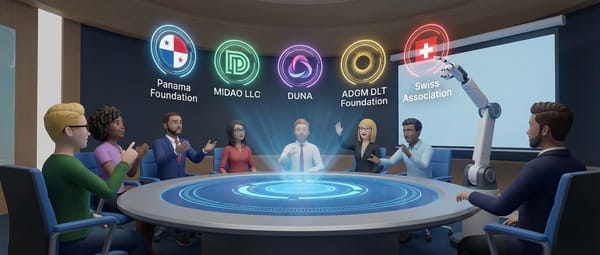
Multisig control represents real-world authority. A token vote without the ability to compel execution is symbolic. Conversely, multisig signers who can refuse to execute governance-approved proposals become de facto gatekeepers. This is in part what leads some projects to use ‘fully wrapped’ DAo structures like the MIDAO LLC and Swiss Association.
Best practice increasingly includes:
- Publishing signer identities (at least within the community).
- Rotating signers periodically.
- Implementing clear execution policies.
- Establishing conflict-of-interest rules.
- Ensuring hardware wallet and key security standards.
From a legal standpoint, multisig signers may be characterised as exercising managerial control. If they have discretion over treasury deployment, their role may be scrutinised under securities, fund management or fiduciary principles depending on jurisdiction.
Foundation operations: the human layer of (most) big DAOs
Most mature DAOs incorporate a legal wrapper for their DAO operations. That legal wrapper will be used as the real world legal node for things like:
- Treasury operations
- Holds intellectual property.
- Enters service agreements.
- Employs or contracts core contributors.
- Interfaces with exchanges and banks.
- Holds off-chain assets.
Foundations - in particular, Cayman foundations and Panama foundations - are currently the dominant form of DAO wrapper. Because such foundations rely on directors / councilors to execute the will of the DAO, this because running a DAO and DAO foundation is hard work, this has led to a new subfield - DAO operations. The relationship between token governance and foundation directors is delicate.
Directors Are Not Smart Contracts
Foundation directors or council members typically owe statutory or fiduciary duties under local law. They cannot simply “do what the token vote says” if that vote requires unlawful conduct or breaches their duties.
This creates a structural tension:
- Governance wants binding authority.
- Directors must exercise independent judgment.
The healthiest structures explicitly acknowledge this tension. Governance frameworks may state that directors will generally implement token-approved proposals unless doing so would breach legal obligations. Clear articulation of this principle reduces future conflict.
Staking and yield activities: operational and legal complexity
Staking operations often blur the line between technical participation and financial intermediation. It can be described as a purely technical function: running validator software, securing a network, and earning protocol-defined rewards. At a surface level, this framing is correct; validators participate in consensus and are compensated algorithmically. However, once staking scales beyond self-delegation, the activity may begin to to resemble financial intermediation
Consider several scenarios:
- The DAO stakes its own treasury assets to secure a network.
- The DAO pools user assets and distributes rewards proportionally.
- A foundation-operated validator set generates yield shared with token holders.
Each scenario carries distinct implications.
Where assets are pooled and returns are distributed proportionally, the arrangement may resemble a collective investment structure. Even absent explicit profit-sharing rights, consistent marketing around “earning passive income” can influence classification.
Operationally, staking introduces additional risk layers:
- Slashing risk
- Validator downtime
- Counterparty risk (if using third-party providers)
- Liquidity mismatch between locked assets and operational needs
Serious DAOs treat staking as a treasury strategy requiring risk modelling, not as a default revenue mechanism. It is important to get early regulatory advice on the risk profile of your intended staking activities.
The illusion of full decentralisation
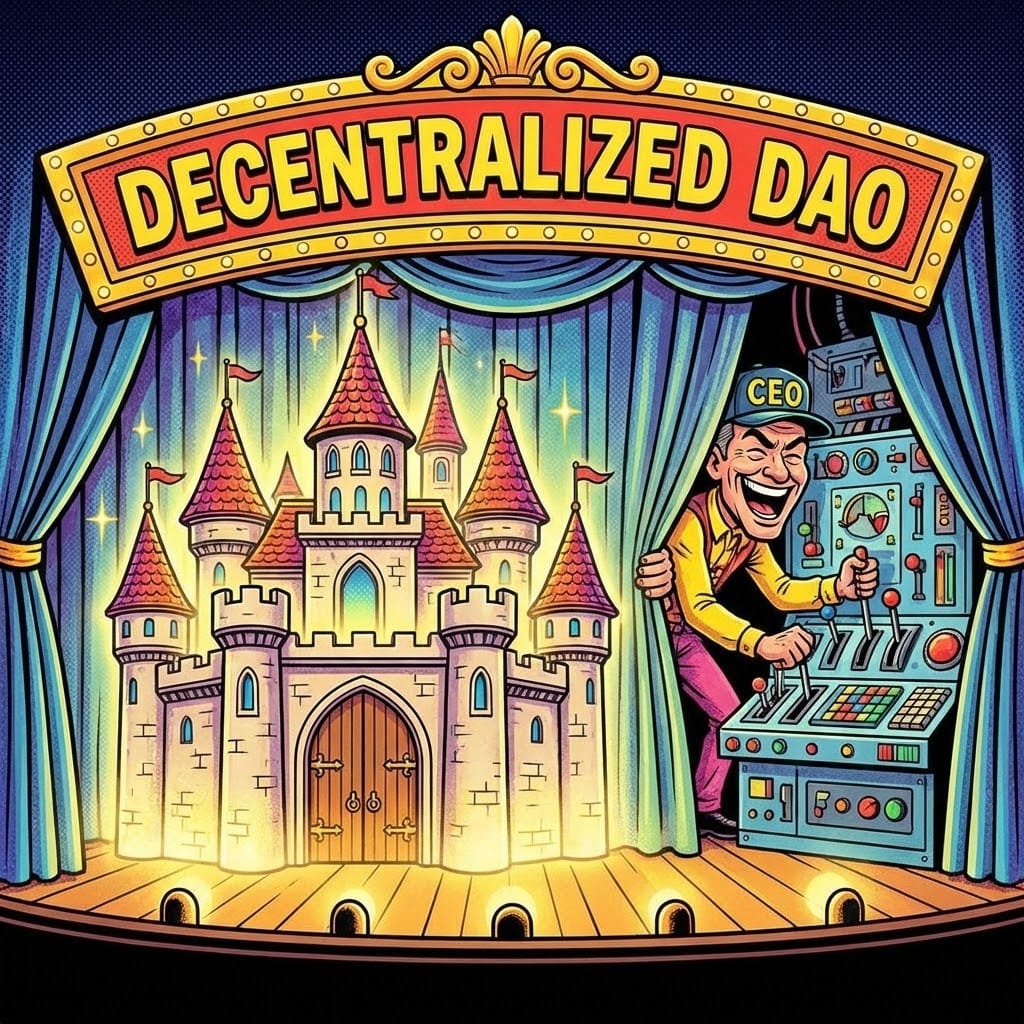
Many DAOs present themselves as fully decentralised while retaining upgrade keys, emergency pause controls or treasury discretion within a small founding group. This is not inherently wrong. Early-stage protocols require coordinated development. The problem arises when there is misalignment between presentation and reality. If there is misalignment - if, for instance, a DAO claims to be heavily decentralised, when in reality is it nothing of the sort - then this will come with regulatory consequences.
Regulators and sophisticated counterparties will examine things like:
- Who controls upgradeability?
- Who can change critical parameters?
- Who controls domain names and front-ends?
- Who has access to treasury keys?
- How concentrated is token ownership?
- What rights does token ownership provide?
Founders should assume that control is assessed based on function, not the story of the DAO and the DAO project. If effective control sits with a small identifiable group, decentralisation rhetoric will not override that fact. If a DAO is a DINO - a DAO In Name Only - it may face a problem.
Wrappers & progressive decentralisation: Mitigating the DINO issue has been one reason why US founders in particular markets pick offshore foundations and token vehicles for their initial project and DAO launch - given the operational needs of early stage projects, it can be difficult to demonstrate that the DAO is truly decentralized. This makes the DAO more likely to be deemed as a security. To avoid this, some founders use offshore vehicles to wrap their project until such a time as they are able to more fully decentralise in a manner that would satisfy US regulatory requirements.
Regulatory awareness without paralysis
A mature DAO does not assume it is immune from regulation. Nor does it allow regulatory uncertainty to paralyse innovation.
Key awareness areas include:
- Securities characterisation of governance tokens.
- Collective investment analysis where treasuries generate returns.
- AML exposure in token distributions.
- Tax treatment of token issuance and treasury income.
- Director duties within foundation structures.
Founders do not need to become lawyers. But they must design with these realities in mind. Economic substance — particularly around pooled capital and profit expectation — consistently shapes regulatory analysis across jurisdictions.
Designing for longevity
Durable DAOs share certain institutional characteristics:
- Clear separation between governance and execution.
- Transparent treasury policy and reporting.
- Responsible multisig management.
- Defined foundation governance structures.
- Realistic token emission schedules.
- Acknowledgment of human accountability.
The most resilient projects recognise that decentralisation is not a binary state but a spectrum. Early phases may require greater central coordination. Over time, authority can be progressively distributed — provided the transition is deliberate and documented.
Conclusion: from token launch to institution
Launching a token is a technical event. Building a DAO is an institutional project.
Governance must be treated as constitutional design. Treasury management must be approached with fiduciary seriousness. Multisig control must be structured transparently. Foundation directors - where they exist - must understand their duties. Staking activities must be analysed economically, not just technically.
Decentralisation does not remove responsibility; it reallocates it. The quality of that allocation determines whether a DAO becomes a durable governance system or a short-lived coordination experiment.
Founders who internalise this early design organisations capable of surviving market cycles, internal disagreement and regulatory scrutiny. Those who do not often discover that code alone cannot substitute for disciplined institutional design.
In the end, the most successful DAOs are not the most decentralised in rhetoric. They are the most coherent in structure, with the most engaged and committed communities, and with the most well-protected and flourishing treasuries.
To learn more about DAOs and DAO legal wrappers, get in touch with us at contact@daospv.com