
BVI incubator funds: a tool for crypto fund structuring

BVI incubator funds are a popular fund option for early stage crypto fund managers. Alongside BVI approved funds, they are a low-cost and flexible fund vehicle that dispenses with many of the requirements and formalities of larger fund structures. In this article, we explain what they are, the documents & roles they require, and how they can be operated. As ever, this blog post is not legal advice.
If you have any questions, or are interested in setting up a BVI fund, feel free to get in touch with us on contact@daospv.com
Why incubator funds exist
The problem: early stage fund managers are badly served
First time and early stage fund managers tend to suffer from a similar set of problems.
- Low capital vs high fund setup costs: First time funds are small - a few hundred thousand dollars, or a low few million. However, in most jurisdictions it can be quite expensive, running into several tens, or even hundreds of thousands of dollars.
- Low capital vs high minimum subscriptions:
- Demonstrating a track record: if you have never run a fund before, it is naturally difficult to demonstrate the success of your trading strategy
The solution: incubator funds and approved funds
Aside from its web-relevant role as a leading jurisdiction for token launches, the British Virgin Islands (BVI) is a globally recognised center for offshore investment funds. In 2015, recognising market demand for lighter-touch structures for emerging managers, the BVI introduced the Incubator Funds and Approved Funds. This regime - established under the Securities and Investment Business (Incubator and Approved Funds) Regulations, 2015 - was designed to enable start-up fund managers to launch and operate investment funds with reduced regulatory burden and cost while building a track record, before converting to a broader regime or winding up.
Incubator funds and Approved Funds sit alongside BVI private funds and professional funds, but occupy a specific niche for start-ups.
This article will primarily deal with incubator funds. A BVI incubator fund is a regulated investment vehicle aimed specifically at emerging or start-up fund managers. Unlike traditional funds, it is subject to limited regulatory requirements, reduced ongoing obligations, and is designed to be a transitional vehicle leading to larger structures as the business grows. If the fund does well, you will have the track record and capital with which to set up and develop a traditional fund. If not, you will at least have saved a lot of money on your fund fees.
BVI incubator fund requirements: The 20-20-20 criteria explained
The incubator regime operates under a set of defined thresholds, often referred to as the “20-20-20 criteria”:
- Investor Limit: Maximum of 20 investors at any one time; all must be sophisticated private investors, meaning they are invited to invest and meet relevant criteria.
- Minimum Investment: Each investor must make a minimum initial investment of US$20,000 (or equivalent).
- Asset Cap: Aggregate net assets must not exceed US$20 million (or equivalent).
- Term: The incubator status is valid for two years, with the possibility of a one-year extension on application to the BVI Financial Services Commission (FSC).
If the fund exceeds the investor count or asset threshold over a sustained period (two consecutive months), it must apply to convert to another fund type (e.g., private, professional or approved fund) or liquidate.
Why use a BVI incubator fund for a crypto fund?
Incubator funds are great for first time fund managers, and great for crypto fund managers. From the perspective of a crypto fund founder, the BVI incubator fund has several advantages when compared to other fund structures:
- No mandatory service providers: Unlike traditional funds, there is no requirement to appoint a licensed investment manager, custodian, administrator or auditor. This saves a lot of money for the fund.
- Administrator is not required: incubator funds do not need to procure a fund administrator
- No audit requirement: Incubator funds don't need to appoint an auditor or file audiented financial statements
- Cost: BVI incubator funds are low cost compared to other fund types
- Speed to market: The fund may commence business just two business days after filing a complete application with the FSC.
- No asset class restrictions: while the overall AUM is limited to $20 million, there are no restrictions on the type of assets they may trade. This is useful for those seeking to trade digital assets.
- Reduced ongoing obligations: Apart from standard regulatory filings (e.g., semi-annual returns and notifications of material changes), ongoing obligations are minimal
- No investor qualification limits: Whereas funds often require investors to have specific minimum limits to their personal wealth and investment expertise, there are no formal qualifications required for investors participating in a BVI incubator fund. This makes it useful for getting family and friends involved. Investors simply must be ‘sophisticated’, which here means they have to be invited to the fund and have no less than $20,000 to contribute.
- No offering memorandum requirement: An offering document is not required, although investors must receive prescribed written investment warnings. See below.
Together, these features make incubator funds fast to launch and cost-efficient, particularly for managers who want to focus on strategy execution rather than compliance complexity.
Investor warnings
Each investor must be provided with a written warning that the fund is an incubator fund, operates under incubator fund restructures, and is not subject to FSC oversight. Where the fund uses an offering document, this must be placed in a prominent place within the document. If no offering document is issued, this should be offered to each investor as a separate document.
Roles and officers in an incubator fund
Although incubator funds are lightly regulated, they still require certain governance and compliance roles. These roles are critical both for legal compliance and for operational risk management.
Directors
Every BVI incubator fund must have at least two directors, one of whom must be an individual. This requirement reflects a core principle of BVI funds governance and ensures that oversight is not concentrated in a single corporate entity.
Directors are responsible for overseeing the fund’s operations, ensuring compliance with laws and regulations, and acting in the best interests of investors. They may also be involved in strategic decisions and risk oversight.
Authorised Representative
An incubator fund must maintain a BVI-based authorised representative at all times. This individual or entity acts as the official point of contact with the FSC and ensures that statutory filings (including notifications of changes) are made on a timely basis.
Money Laundering Reporting Officer (MLRO) and compliance functions
Although the incubator regime does not require a custodian or auditor, funds remain subject to anti-money laundering (AML) and counter-terrorist financing (CFT) requirements under BVI law. An incubator fund must therefore appoint an MLRO, and ensure that compliance measures (including AML policies) are in place. In practice, one of the directors may serve as MLRO, or the function may be delegated to a service provider.
Other compliance roles
In addition to the MLRO, incubator funds must usually designate a responsible officer for matters such as FATCA/CRS compliance and liaison with the BVI International Tax Authority. These roles help ensure global tax compliance for investors.
Optional Service Providers
While not mandatory, many incubator funds choose to engage administrators or third-party managers to support NAV calculation, investor reporting, or compliance functions — particularly if the manager anticipates converting to a larger structure or attracting institutional investors.
Feeder entities and their relationship to the fund
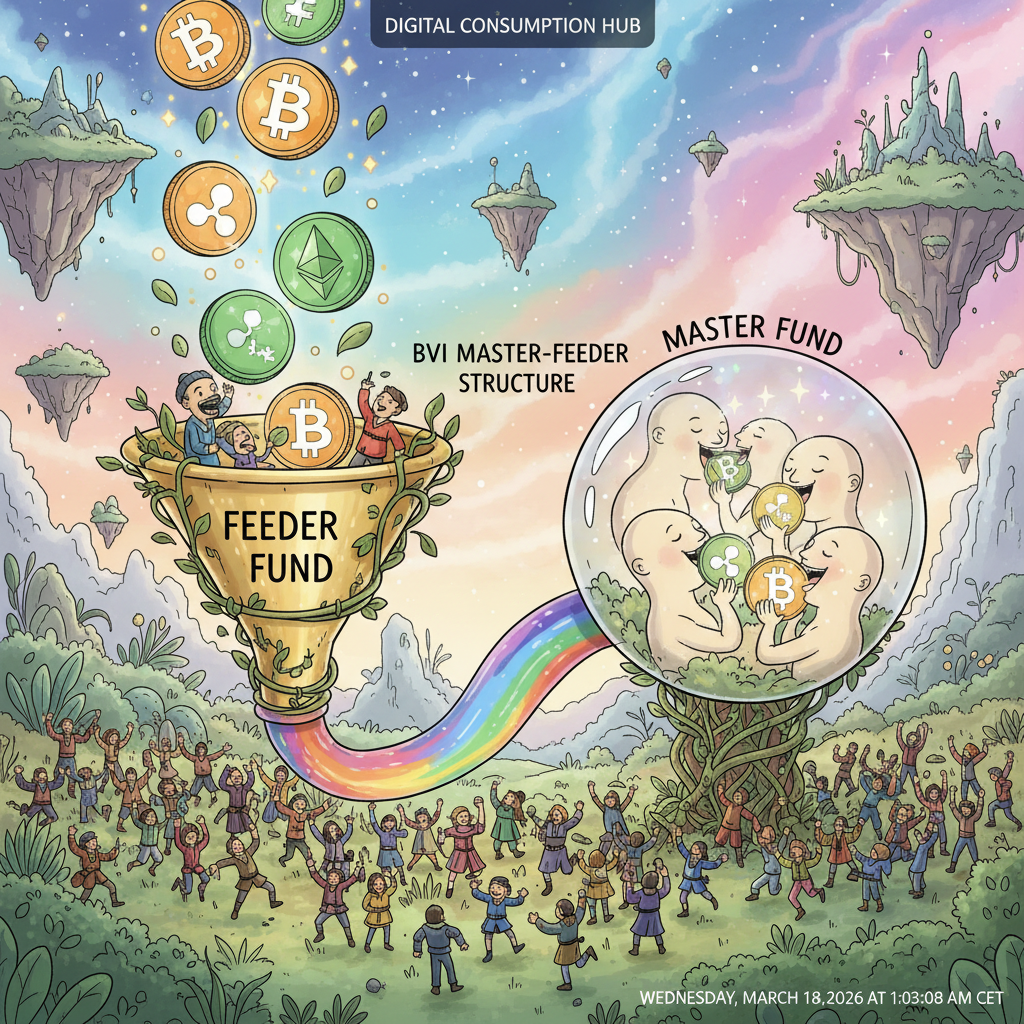
In many international asset management models, funds use master-feeder structures to accommodate different investor types and regulatory requirements. A feeder entity is typically a separate legal vehicle that pools investor capital and then invests that capital into a central “master” fund. At core, they are tools for managing tax exposure, investor segmentation, and regulatory constraints
Feeder entities play a particularly important role in the context of BVI incubator funds, not only for tax and regulatory reasons, but also as a tool for managing the structural constraints of the incubator fund regime.
Why use feeder entities with a BVI incubator fund?
Feeder entities can be useful where:
- Tax and regulatory blockers are needed: Investors are subject to local regulatory or tax considerations that make direct investment into a BVI incubator fund less attractive or impractical.
- Fund Managers want to segregate investor classes: Different types of investors - e.g., U.S. taxable investors, US non-taxable investors, and non-U.S. investors - can have different regulatory needs. Segregating these into different feeders means a single unified investment strategy can be maintained, while also ensuring that the differing investor needs can be managed more easily. It is important that investors do not accidentally find themselves needing to comply with the wrong rule.
- Local requirements in source jurisdictions: Certain investors prefer or require investment through a local corporate entity or vehicle for regulatory reasons. In this case, a feeder entity can be created for their needs.
- Fund tokenization: A feeder entity can be tokenised and thus offer on chain investors access to fund returns. See the next section.
In practice, a feeder vehicle may be established in another jurisdiction (e.g., Delaware or England) and will then invest into the BVI incubator fund as a master. This allows the BVI fund to remain the central execution vehicle while providing tailored legal and tax treatments to different investor groups.
Although the incubator regime itself does not require feeder structures, they are frequently used to raise capital for them. This follows wider trends in fund structuring, particularly as a fund scales and seeks broader capital.
In short - you can set up another entity and use this to pool capital. This entity can then be one of the 20 investors into the BVI incubator fund.
For crypto fund founders, the practical implications of this are that the BVI feeder entities can be a way of channeling US capital into the incubator fund, and - because the feeder entity is a corporate entity, which can be owned by more than one person - as a means of giving a wider pool of investors access to the fund.
Tokenizing a BVI incubator fund
This occurs in two paths. Firstly, a fund can tokenise the shares of its own entity, which will typically be a BVI Business Company. Alternatively, it can tokenise the shares in another entity, one that owns some of the shares of the fund - a feeder entity.
In practice, tokenisation is most commonly implemented at the feeder level rather than at the level of the incubator fund itself. One or more of the permitted 20 investors may be a corporate vehicle acting as a feeder, through which multiple underlying investors participate. The equity interests in that feeder can then be represented by tokens.
This approach allows managers to introduce tokenised participation while preserving a single investor entry at the fund level. However, care must be taken: depending on the structure, regulators may “look through” the feeder to the underlying tokenholders, which can create issues with the incubator fund’s investor limits.
From a regulatory perspective, the key issue is not the use of a particular blockchain, but the ability to control investor admission and transfers. In practice, tokenised feeder structures typically use permissioned or whitelisted systems to ensure that only eligible investors can acquire and transfer tokens, and that AML/CFT and investor qualification requirements are met on an ongoing basis.These will admit new tokenholders, subject to the standard BVI CDD approvals, plus additional ones such as “live” matching of the investor to the wallet, as well as adhering to selling restrictions of the Fund.
Whether such tokens can be freely transferable or admitted to trading on secondary markets depends on a broader securities law analysis across relevant jurisdictions. In most cases, transferability is restricted to maintain compliance with private placement exemptions and investor eligibility criteria.
When not to use a BVI incubator fund
The BVI incubator fund is not suitable if you are looking to:
- Set up a large fund: BVI incubator funds are limited to an AUM of $20 million - a small amount in the fund world
- Receive a large number of investors: with a cap of 20 investors, the incubator fund is no good for those needing to get a wider pool of investors. BVI Approved funds can be a good alternative option, as they have a cap of 50 investors. However, if you need more you will need to explore other fund types.
- Receive retail investors: this structure is not designed for retail investors
- Set up a long-lasting structure: BVI incubator funds only last for 2 years with a potential 1 year expansion.
Costs and timelines for setting up a BVI incubator fund
Costs: Setting up a BVI incubator fund involves
- Setting up a legal entity
- Hiring directors (unless you provide these yourself) and Authorised Representative;
- Hiring (or providing) compliance staff, and
- Preparing legal documents, such as your subscription agreement.
- Submitting the application to the FSC
Due to the different service providers involved and the possibility of you doing some of this in house, fees vary - but you can expect a range of $22,000 to $35,000 in total. To learn more, contact us on contact@daospv.com
Timelines: BVI entities can be set up in 2 days; BVI incubator funds can start work as little as 2 days after filing their application. Practically speaking, the time-consuming element is not the entity setup - it is getting all your application and KYC documentation together. As a rule of thumb, we advise founders to keep aside 1 month for this.
How to set up a BVI iIncubator fund
Setting up a BVI incubator fund is a structured but relatively straightforward process — particularly compared to more heavily regulated fund regimes.
1. Choose a legal structure
Most incubator funds are established as a BVI Business Company with an open-ended share structure (often redeemable participating shares). Alternative legal forms such as limited partnerships can also be used, depending on investor and tax considerations.
2. Prepare constitutional ocuments
Draft the fund’s constitutional documents (e.g., memorandum and articles of association), which define governance, investment strategy, redemption rights, investor protections and key terms. While an offering memorandum is not required, clear documentation that explains the fund’s strategy and risks to investors is essential.
3. Appoint the required officers
Before making an application, ensure that:
- At least two directors (including one individual) are appointed.
- A BVI authorised representative is designated.
- AML/CFT compliance functions are covered, including appointment of an MLRO.
4. Submit application to the BVI FSC
Submit an application to the FSC along with:
- Constitutional documents
- Details of directors and authorised representative
- A description of the investment strategy and investor target group
- Confirmation that the fund meets the incubator thresholds and investor criteria
Once the FSC receives a complete application, and assuming there are no regulatory concerns, the fund can begin operations two business days later.
5. Meet ongoing compliance obligations
After launch, incubator funds must:
- Notify the FSC within 14 days of any material changes.
- Prepare and submit unaudited annual financial statements, though audits are not required.
- Submit semi-annual returns detailing investor count, NAV and other indicators.
- Ensure the fund remains within the investor and asset thresholds, else initiate conversion or liquidation.
6. Plan for conversion or liquidation
Incubator funds must plan for their eventual lifecycle end, either by conversion to a broader fund category or orderly wind-down. Early engagement with legal and regulatory advisors on conversion triggers can smooth this transition and support investor confidence.
Conclusion
BVI incubator funds offer a compelling, cost-effective, and fast-to-market vehicle for emerging fund managers seeking to establish a track record and attract sophisticated investors under a regulated framework. With simplified governance requirements, flexible operational structures and a clear conversion pathway to larger fund products, incubator funds have become an integral option in the global funds landscape. Managers should weigh the operational advantages against the limitations on investor count and fund duration, but for many start-ups, the incubator regime provides a valuable pathway into professional fund management.
If you have any questions, or are interested in setting up a BVI fund, feel free to get in touch with us on contact@daospv.com